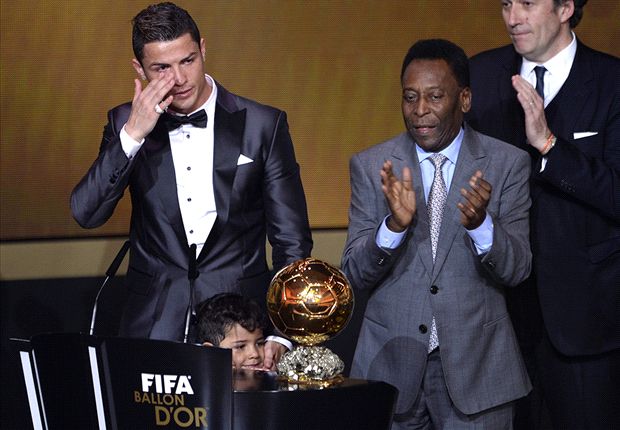
Cristiano Ronaldo was visibly emotional as he was crowned the world's finest footballer for a third time, but for those who saw him growing up in a poor part of Madeira's capital Funchal, it was a familiar sight.
Raised
in the mountainous outskirts of the island's largest town in an area
called Santo Antonio, Ronaldo's childhood was anything but easy. The
fourth child born to Dolores and Dinis, his arrival had been unplanned.
His mother, a cook, and his father, a municipal gardener who lost his
long battle with alcoholism in 2005, struggled to put food on the table.
Given
the name Cristiano by his mother and Ronaldo by his father after Ronald
Reagan (Dinis' favourite actor and then President of the United
States), the young boy soon sought distraction on the football field.
And after accompanying his father to local side Andorinha, he went along
as a seven-year-old to play with his cousin Nuno - and never looked
back.
Francisco
Afonso, a primary school teacher who was Ronaldo's first coach, was
impressed from the outset. "He was something special from the start -
you could see that," he told
Goal. "He was small but so
determined. He started as a defender but soon moved up the pitch
because he wanted to be involved in everything. He was good with both
feet and fast, with good technique because he never stopped practising -
and he always wanted the ball. Football was everything to him and if he
couldn't play, he was distraught."
 Made in Madeira |
 An image of a young Ronaldo at his first club Andorinha
Rui
Alves, a childhood friend who remains close to the Real Madrid forward,
says Ronaldo only ever wanted to play football. "We would go out and
play all day, but Cristiano kicked his football all the time," he said.
"I tried to get him to play other games, but he only ever wanted to play
football. We would go to the bakery at the end of the day to wait for
the cakes that hadn't been sold as a treat, but everywhere we went, he
took his ball with him."
And at Andorinha, the now three-time
Ballon d'Or winner soon made his mark. Ricardo, a team-mate of the
Portuguese who still works at the club's bar, remembers Ronaldo's
competitive streak. "He was streets ahead of the other players," he
said. "You could see that, even at such a young age. But if he didn't
get the ball, he was upset - and when we lost, he cried."
But
so talented was the young Cristiano that in one match, he fired a
hat-trick in the first half to give Andorinha a 3-0 lead at the break,
only to take a blow to the head late in the opening period. He was
carted off to hospital for examination at the interval and when he
returned later on with his head all bandaged up, he was devastated to
learn that in his absence, Andorinha had capitulated and lost 4-3.
Ronaldo's
performances began to make waves on the Atlantic archipelago and he was
soon snapped up by the island's biggest team, Nacional. At the age of
12, he was due to sign official terms as a youth player, but by then,
many had realised that the skinny youngster was built for bigger and
better things and a Madeiran magistrate named Joao Marques de Freitas
got in touch with a scout at Sporting Lisbon, Aurelio Pereira, to
discuss a possible trial for Ronaldo on the mainland.
 Ball in hand |
 Ronaldo (bottom right) in an image proudly kept by his old club
"I
met Ronaldo when he was 11 years old," De Freitas told Goal. "His
godfather introduced me to him and told me he was a very good player. He
was very, very small - very slight and fragile.
"I got in touch
with the man who was in charge of Sporting’s scouting and I told him:
‘There is a kid who they say is extremely good.’ But he said: ‘That’s
very young’ and he told me we couldn’t send a boy that young to Lisbon.
"So
I spoke to Cristiano’s mother, who was a very humble and very poor
person. And she authorised it. So we got him a return ticket to Lisbon
and Cristiano went with a sign around his neck made of cardboard, with
his name on it to identify himself. Mr. Aurelio was there to meet him at
the other end and he spent four days in Lisbon."
Sporting's
scouts were indeed impressed with the young Madeiran and a deal was soon
struck. Nacional still owed Sporting €25,000 for formation of a player
they had signed previously and they told the capital club that if they
pardoned that debt, they could have Ronaldo for free. Nevertheless, that
was still a lot of money for an 11-year-old, and the two teams vowed to
keep the details of the deal a secret.
 Change of scenery |
 Ronaldo's family now live in a more exclusive area of Funchal
Sporting's
academy is the finest in Portugal and had a knack of developing
world-class wingers, like the great Luis Figo. Ronaldo's mother, a big
Figo fan and Sporting supporter, was happy with the idea of seeing her
son in the famous green and white and, at the age of only 12, the
youngster made his move to the mainland.
Times were tough at
first as the young Cristiano grew homesick and was bullied by other boys
because of his thick Madeiran accent, which they found funny. "He had
problems early on but he triumphed because of his very unique
personality," De Freitas added. "He is a winner and he had that fearless
determination from a young age.
"He was a fighter, a street kid.
His father was a very unhappy person and died some years ago. So
Cristiano had a very difficult childhood, but he always knew how to
respond and he grew when times were tough. So when [Fifa president Sepp]
Blatter made those remarks about him [calling him a 'commander' in
2013], he said: ‘I respond on the pitch’ - and he did. In that respect,
Blatter was right. He is a commander."
Childhood friend Rui
added: "People don't know him. They think they do but when you are with
him he is such a kind and generous person. He doesn't come back here [to
Santo Antonio] because many of these guys don't work and they ask him
for money, so he stays away, but he is still the same person today.
"We
are still in touch and he always has time for us," another friend -
Ricardo - explained. "It's funny, when I was younger I used to watch
Pauleta, who is from the Azores (another group of islands in the north
Atlantic) playing for Portugal and think 'why can't we in Madeira have a
player like that?' And it turns out we had one who was even better!
"For many people, Cristiano has put this island on the map and we will always be grateful for everything he has done for us."
So
as the 29-year-old roared in delight upon collecting another Ballon
d'Or, you can bet that many in Madeira were boisterously shouting at
their televisions also. Both in nostalgia and pride for the man they saw
grow from poverty to again win football's greatest individual prize.
 RSS Feed
 Twitter


 07:51
07:51
 Unknown






 Police in Florida have arrested John Nicholas Jonchuck Jr., a father accused of throwing his 5-year-old daughter off of a bridge in Florida.


